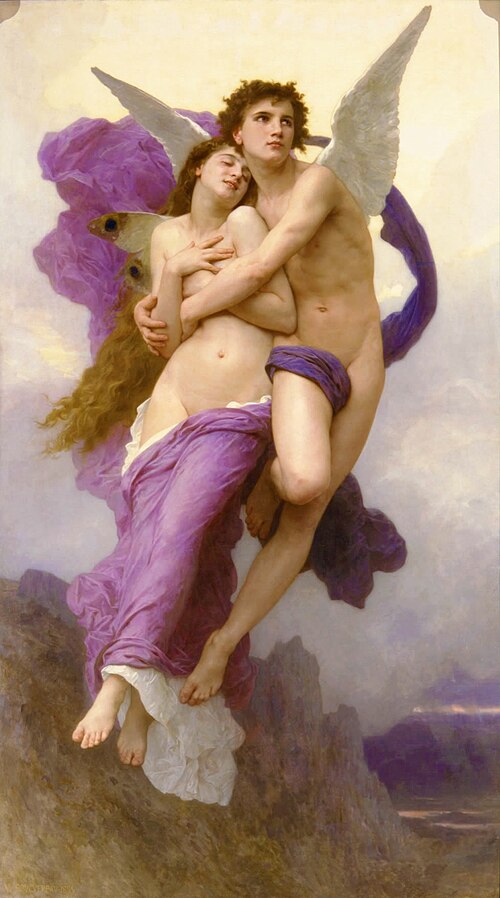
Once there lived a princess so stunning that she exceeded all other mortal women in loveliness such that even goddesses envied her. People came from all over the world to admire Psyche, and they were so smitten with her “maidenly majesty” that they even started paying her the divine honours typically reserved for Aphrodite, whose ceremonies were being neglected and whose temples defaced.
Furious at this, Aphrodite sent her son Eros among the mortals with a simple mission: to fuel in Psyche love for “the most miserable creature living, the most poor, the most crooked, and the most vile, that there may be none found in all the world of like wretchedness.” In the process of this he accidentally pricked himself with his arrows, so the minute Eros laid his eyes upon this beautiful mortal maiden, he fell in love with her.
In the meantime, the lovely Psyche was alone and lonely. Her two elder sisters had already been married to two royal princes, but Psyche had no suitors. Not one. For her apparent perfection induced such awe that no one had the courage to propose and Psyche felt herself cursed, not blessed. So it was that her father travelled to Miletus and asked Apollo’s oracle for counsel on how he could best wed his daughter, only to hear the following, typically cryptic, advice…
“Hope for no mortal bridegroom. Your lovely daughter will be wed to one fierce and wild who burns with fire as hot as a dragon’s breath. Her future husband awaits on yonder mountain peak.”
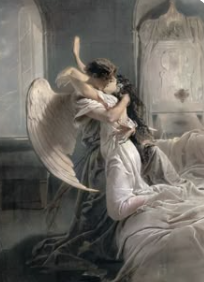
To meet this monstrous being Psyche must be clad in her mourning garments and left alone on the rocky peak of a desolate and inaccessible mountain top exposed to sky and empty air. Little did anyone know that the god so described by the oracle was none other than Eros. Soon after, before any dragon could appear, the frightened Psyche was lifted by Zephyrus, the West Wind, who wafted her serenely away to a hidden valley and the castle of Eros, and laid her ever gently in a bed of most sweet and fragrant flowers. In the midst of a magnificent forest Psyche happened upon a heavenly palace, so luxurious and splendid that even Zeus himself would have approved. After being provided by a host of invisible servants with the most delectable of foods and all kinds of pleasurable things, Psyche retired to bed and in the hours of darkness, Eros came and got into her bed with soft murmurs and tender kisses. Psyche could hear him, smell him, feel him, but she could not see him. In the morning she woke up alone. The following night was the same. Although it was unusual and strange, her husband was kind and loving. Psyche found her passion for him and grew accustomed to the strange arrangement.
And so the days passed for Psyche who, for a while, wished for nothing more and couldn’t help but think that nothing could ever spoil her happiness. Eventually however, after becoming pregnant, she began to long for her family and so asked her still unseen husband, who had explicitly told her that he would leave if she ever saw his face, if it would be possible for her sisters to visit her from time to time.
Eros agreed and so it was that many, many embraces and kisses were shared between the three sisters during their reunion. However, with every next visit, the elder sisters of Psyche grew more and more envious of her extraordinary fortune. And when Psyche once confessed to them that she had no idea what her husband looks like, they taunted that her husband must be the ugliest of beasts, what else could explain such mystifying behaviour.
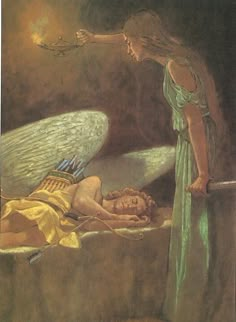
That very night, after their lovemaking, Psyche, overcome with curiosity, approached the blissfully asleep Eros with a lamp and also with a knife. Awestruck and overcome at what she beheld, in her confusion she too pricked herself on one of Eros’s arrows, the hand holding the lamp now began to shake and a drop of burning oil fell from her lamp upon the shoulder of Eros; this awoke the god momentarily and, just as soon as he realized that his wife had broken her promise, he fled without a word.
Not knowing what to do, the bereft Psyche started searching. Distraught she wandered through country after country and prayed for help, but it was all in vain. Even Demeter and Hera, afraid they might offend Aphrodite, refused to aid Psyche on her quest. Seeing no way out, Psyche eventually came to the altar of Aphrodite herself.
Furious that her son had made such a match with a mortal, the goddess of love and beauty showed no mercy. First, she shook Psyche violently by her hair and tore her tunic, mocking her for conceiving an illegitimate child; then she handed her over to her two servant-maidens, Sorrow and Sadness, before beginning her torment of being given a series of impossible tasks.
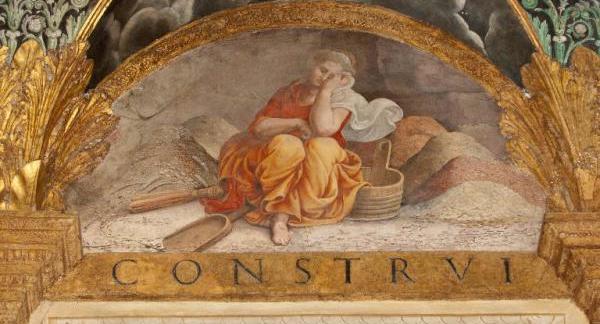
For the first Aphrodite took a great quantity of wheat, barley, millet, poppy seed, peas, lentils, and beans, mingled them together in a heap and tasked Psyche with the job of sorting them all into separate piles by nightfall. Overcome with the enormity of the task, Psyche became very still and began to weep. Fortunately, an ant heard her and feeling compassion for her quickly came with all the ants of the country to help Psyche finish in time.
Next, Aphrodite tasked Psyche with gathering the golden wool from a nearby flock of wild and murderous sheep with sharp horns. This time, aid came from a divinely inspired reed that advised her to wait until the sheep fall asleep in the heat of the afternoon, and then to gather the locks of their golden fleeces hanging upon nearby briar bushes. Psyche followed this advice and brought Aphrodite a lapful of golden wool, but still the goddess was not satisfied.
Aphrodite’s third task was for Psyche to fill a jar with the waters from the black and deadly river Styx, which flowed from the top of a distant mountain. After much difficulty, Psyche found that the ravine sides were too sheer and the waters raging too furiously; this time Psyche froze with fear and was so out of her mind that she wasn’t even able to cry anymore. Seeing her there, Zeus’ eagle suddenly flew down from the clouds and snatched Psyche’s jar out of her hands and swooped down, filled it to the top with the waters of Styx and brought it back to her.
Psyche returned to Aphrodite and presented her with the jar; only, by way of spiteful thanks, to receive the fourth and final task, in which Psyche was commanded to go to the Underworld and ask Persephone for some of her beauty ointment, and bring it back for her. Now, with everything lost, even hope, Psyche climbed to the top of a nearby tower determined to throw herself off and thus to descend to Hades that way. But as she stood poised and trembling on the ledge, a voice from the tower said to her, “If you do it this way, you will indeed arrive in the underworld but you will have no way to return. Listen carefully.”
The voice told her about the cave where she could find the long circuitous road down. It told her about Charon the ferryman who would require payment and Cerberus the three-headed dog that guards the banks of the river Styx. And that she was to take two coins and two barley cakes, to pay each of these on the way in and again on the way out again. Then the voice added, “You will see desperate creatures and strange apparitions in the Underworld and you must not stop to listen or to aid, but harden your heart. When you reach the throne of Persephone, she will offer you a banquet meal and a soft couch upon which to rest. Accept nothing but a crust of bread and be seated upon the ground. When you have the box of ointment you must come straight back, on no account must you open it.”
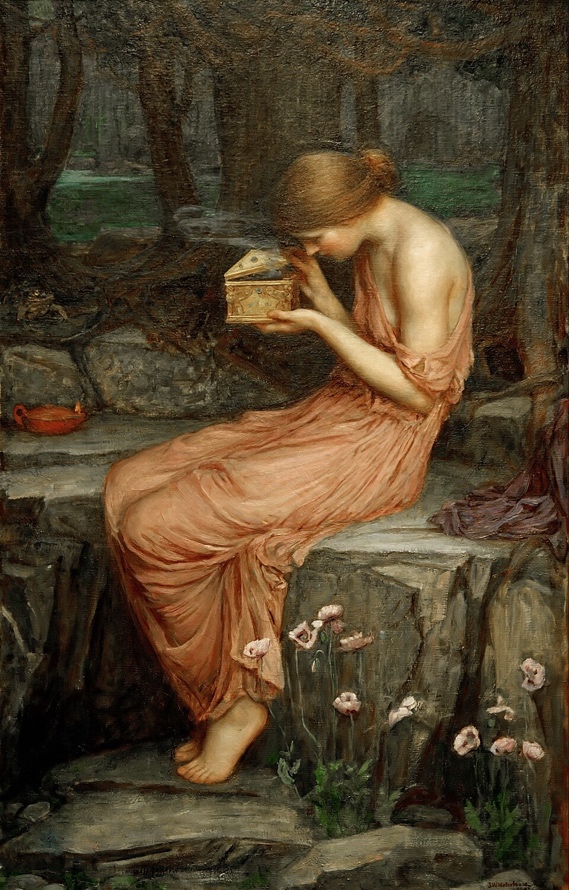
Psyche listened carefully to these instructions and somewhat heartened, climbed down, collected her coins and her cakes, and found the cave. Her journey to Hades progressed just as the tower predicted. On the road down she met a lame man with a lame donkey carrying a load of wood who begged her to stop and help him pick up the sticks that had fallen but she passed him by in silence. When she was crossing the river Styx a drowning old man begged her for pity but she made no move to help.
Then she met a pathetic old man anxiously tying and untying a piece of black and white cloth but she averted her eyes and walked on. Three mysterious old women sat weaving near Persephone’s gates but she ignored them too, refusing the offered seat and meal. At last, she had the box full of beauty ointment.
Psyche was so relieved and buoyed when she ascended once more into the light of day. She had been down to the underworld and back up again! Her tasks accomplished she allowed herself, at last, to recall her beloved Eros and imagine that she might see him once again. He was a fair and glorious god and she loved him so deeply, yet was herself but mortal. He had fallen in love with her because she was beautiful but after all of her wandering felt herself to be a tired, pregnant, unwashed, unkempt and unlovable wretch.
Look at you now, she scolded, how could you possibly attract a god? Ah, but this box contains the beauty of the goddess, if only, she thought, just a little, as she tentatively opened it, just a little for a peek, only to release a dark mist that swirled out from within to overcome her. Psyche fell down motionless, in a deathlike slumber, where she lay, in the middle of the road, like a sleeping corpse.
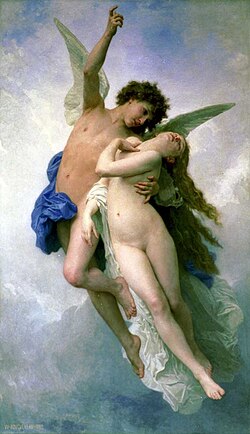
Eros, who could bear the absence of Psyche no longer, flew out through a window of his chamber and, upon reaching Psyche, wiped away the cloud of sleep from her face, and put its essence back in the box. Then, he lifted his treasured wife into the air, so that Psyche was able to give her present to Aphrodite. Not wishing to see her suffer further Eros immediately went to Zeus and begged him to make Psyche immortal by giving her ambrosia, not only so that she and Eros could be united as equals, but also so that Aphrodite might finally be appeased. In due time, Psyche’s baby was born, a healthy daughter whom the married couple named Pleasure.
Notes:
The earliest and primary source for this fairytale is Apuleius’ novel The Golden Ass, written during the second century CE, drawing itself upon ancient Greek sources. Since then however, it has resurfaced in countless versions, variations and retellings, of which this is just one more.
Psyche and Eros ~ A commentary
There are two myths, that of Parsifal and Psyche, which seem to be representative of two ways of being which epitomise two very basic and entirely complementary patterns of development of the masculine and the feminine. The astrological alphabet can be similarly divided, the fire and air signs (Aries, Leo, Sagittarius, Gemini, Libra and Aquarius) being more masculine in nature and the earth and water signs (Taurus, Virgo, Capricorn, Cancer, Scorpio and Pisces) being more feminine. These terms can be taken as either meaning men and women, or as the development of the masculine and the feminine in both men and women. Robert Johnson describes the two ways of being as the focused consciousness of the masculine and the diffuse awareness of the feminine. Their quests, as described by these myths, are very, very different.
In some ways it is possible to look at the Sun in the horoscope and relate it to the mythic hero or heroine. Psyche is, in a sense, the Sun in a woman’s chart and has more to do with embodiment, while Parsifal, representing the Sun in a man’s, is more about manifestation.
To begin the story, we have Psyche, (which is Ancient Greek for “Soul”), a maiden of unearthly beauty. As she grows up this beauty is noticed more and more so that in time she begins to be worshipped as the most exquisite creature ever born, even more beautiful than the goddess Aphrodite herself. This makes Aphrodite not only very jealous but outraged that she should be compared to a mortal.
Aphrodite’s anger will only be appeased if Psyche is offered to a dragon monster and left exposed and vulnerable at the peak of a rocky mountain, to await her fate. Eros, her son, is sent to oversee things and ensure that all goes to plan. Unfortunately, in the process he manages to prick himself with one of his own love arrows and so falls helplessly in love with Psyche. Without telling his mother, Eros carries her off as his bride.
These are common enough themes, perhaps suggestive of the feminine journey being one that begins from some or other necessity that is taken on as a result of circumstances rather than choice. There is no judgement here and certainly no fault, it simply is so. Psyche is chained to a physical rock, but there are so many others in life. The most common rock traditionally being that of biology, but each woman will have her own.
As far as our tale goes, they are for a time blissfully happy. However, as a god Eros has demanded one condition from his bride: she is not allowed to ever see his face or know his identity. None the less she is treated with great love and they enjoy the physical delights and sensual pleasures of their union.
Inevitably though, Psyche becomes curious, the beginnings of consciousness begin to stir within and her jealous sisters (shadow sides) taunt her with questions and fill her with doubts about her husband claiming that she must be under an evil spell of some hideous monster, so one night she determines to see for herself. Taking a knife and an oil lamp, she creeps in upon Eros one night as he is sleeping. For here one must have both a lamp (a symbol of illumination or consciousness that allows us to see the situation clearly) and a knife (the power to act decisively, to be able to sever bonds).
To her utter amazement, Psyche sees no beast at all, but the divinely beautiful god Eros. In her confusion she also pricks herself on one of the arrows in Eros’ quiver, and falls even more in love with him. But from her trembling hand she also spills a drop of hot oil from her lamp on his shoulder, the pain of the burn awakens him, so there they are confronting one another, she with her astonishing discovery of the real nature of her husband, he with the horrified realisation that she has found out his secret. So he leaves her, fleeing because as a god he cannot be seen with a mortal.
Distraught, and even more desperately in love now, Psyche determines to find him, and so her quest, her journey, her spiral descent begins.
Enter Aphrodite, the mother-in-law to be, who, still venomously hating her human rival begins to set up a series of tasks to obstruct, defeat and break her. So it is that Psyche must undergo a series of labours, as does every heroic figure, male or female. At each step of the way the goddess tries to thwart her, Psyche curiously nevertheless prays at the altar of Aphrodite for guidance, understanding that it is so, that whatever has wounded you will also be necessary for your healing.
In a sense these tasks represent what the feminine psyche must learn in order to grow. On completion of each of the four tasks, the woman who identifies with Psyche or the Handless Maiden has become competent psychologically in ways she was not before. Psyche’s first test is that she is given an enormous heap of seeds of every conceivable size and shape, and is told that she must sort them before nightfall. This is an inhuman task because there are so many millions of seeds. If she fails, then the goddess will kill her.
Despite beginning her task Psyche soon becomes distraught and despairing at the enormity of what she knows she cannot do and simply sits, is still and weeps, as she does so, ants come from deep within the earth and complete the task for her. By sunset Aphrodite finds the seeds are all neatly arranged in piles.
Similarly, when she attends to the task of sorting a vast number of different seeds into separate mounds, a woman acquires the ability to sort out possibilities, to make order out of confusion, to learn that she has the psychological, intellectual, or intuitive means to sort out and make sense of what she faces when she is on her own.
Furious, Aphrodite gives Psyche her second task which is to acquire some fleece from the golden rams of the Sun, which are huge, fiercely aggressive man-eating rams that butt heads and horns in their ceaselessly competitive fights for dominance.
This might be interpreted as the need to find a way of getting a symbol of power for herself without being trampled or destroyed in the effort. This is the same task a woman must do when she goes out into the competitive world and must fend for herself. She has to learn to acquire the golden solar power she needs without losing her soul and becoming tough, unrelated to others, and out of touch with her feelings and values.
Again, Psyche is overwhelmed at what she must do and again gives way to her grief at the thought of her impending failure. Again, from out of her stillness, help comes from an unlikely source in the form of the reeds whispering that they will collect the wool from the rams as they wander past and that Psyche can collect it from them at dusk. This she does and to the chagrin of Aphrodite who sets her a third task.
This requires that Psyche collect a vial of water from the River Styx. This is both deadly poison and confers immortality. But it’s impossible to get water from this river, because it is surrounded by jagged rocks and full of torrential rapids. Overcome, and forlorn once more Psyche is about to cast herself from the rocks when an eagle suddenly appears and offers to collect the water in the vial by swooping down into the deep river gorge.
In a sense this task requires that Psyche gain the overview perspective of an eagle as well as the eagle’s ability to discriminate and grasp what it wants. When a woman has learned this, she has gained the ability to see patterns and act decisively on her own behalf.
Note how when faced with each of these tasks, Psyche, unlike the typical male hero, doesn’t do ‘any thing’ or deed as such. She doesn’t go out and unseat any knights or rescue any damsels. She slays no monsters, wields no clubs, conquers no kingdoms and redeems no omens. Instead she remains in the stillness that is at the well of her interior feeling self and gives vent to the untainted expression of these feelings, for only in stillness can the feminine be healed. This seems to invoke some instinctual life force which can aid her because it knows a solution she herself could not possibly come to. Psyche learns to rely on her own natural knowing self and her connection with nature and life itself. Throughout she maintains her relationship with the unseen forces of the world around her all in the quest for the integration and completion of her own self love and union with the god of love which so often underlies a part of the journey of the feminine, even though this is embodied in another. Either as an image of the external pattern of relationship or of the internal pattern where a woman seeks union with her own creative spirit.
Aphrodite, furious now at Psyche’s survival, claims that the stress of caring for her son made her depressed and ill. This, as a result of Psyche’s lack of faith, has caused her to lose some of her beauty and that for her final task she must fetch some of Persephone’s ointment which is said to confer beauty and immortality. To do this Psyche must journey down to the very underworld itself. To succeed, she is told to receive instructions from a tower, the very tower she was about to throw herself from as the only way, or so she thought, to get to the underworld. Atop the tower she receives some instructions that are very clear, she must pay the ferryman who takes her across the river Styx, that is to say, she pays her dues, she is also told to pay no heed to the hands of the drowning that cleave at her from the water. Then she must appease Cerberus the three headed dog who guards the entrance on the other side and on her return she must not open the bottle.
What she must do now is to descend into the very underworld itself. To face the darkness of her own mortality and the inner spaces of her soul, to bow herself before Hades altar and then return. Orpheus is the only other mortal to have succeeded in doing this. The image of the tower here is instructive. A tower is a man-made cultural edifice, a structure with foundations and encoded timeworn instructions firmly embedded in the earth. In other words an ancient tradition or pathway with annals that go back deep in the past and embedded with clear instructions for the initiate who has come this far. Make no mistake, this is depth work, not some weekend workshop.
Entering the underworld
Throughout this story Psyche displays an exceedingly curious mix of on the one hand passivity and on the other, utter commitment and determination and dreadful as her tasks might be it is only in attempting them that she can become a fitting companion for the divine. Remaining unconscious or asleep, living an unexamined life at the side of her invisible partner is no longer an option. In order to grow, Psyche herself must learn to grow; each aspect of this growth and its required tasks seem impossible until helpers from the natural world come to her aid, ants, reeds, an eagle, and an instruction imparting tower (all symbols for qualities within her).
Following the instructions etched into the structure of that very tower Psyche is able to enter the underworld, that is her own inner depths, only because she is able to adhere to what she has been told, to pay her dues, acknowledge and feed her instinctual self and say no to those who cleave at her to come to their aid. She gains the ability to do what every woman must learn to do. For on this occasion she is not there to rescue people or do for them, on this committee or that, for the cost of doing so would trap her in fulfilling others needs and not her own. Her growth becoming stunted, she would become further removed from the possibility of becoming whole herself, for there are times in our life when it is necessary to say no to others and attend to our own inner imperatives. This then is a necessity of the long and solitary pathway down to find her interior depths and the gods that dwell there.
At the end of her long and perilous journey Psyche comes finally face to face with Hades Lord of Darkness himself, but Persephone takes pity on her, spares her and gifts her some of her precious ointment. So begins the return, which as Joseph Campbell notes is the most perilous part of the journey. Note that Psyche does not sit on the couches of Hades and Persephone or partake of their banquet because to do so would be to abort the journey and make no further development. Here is another of those roads less travelled by and highlights a dangerous moment, for to sit with the gods is to identify with them which is a hubris a mortal cannot do and must not attempt. Some women remain here, living comfortable and performative lives, but without further growth.
As one might well imagine she fails, which also seems to be a necessary part of the pattern, as right at the end when daylight appears in the distance on the long way up she pauses and opens the ointment thinking that she might make her filthy, task worn, dishevelled and pregnant self, beautiful once more for her beloved Eros. It is here that her (our) necessary failure invokes the masculine side of herself, that is her inner Eros. The moment she touches the ointment, she sinks into a deep, deathlike sleep. Just as she is near death, Aphrodite relents and allows Eros to save her and the whole story is redeemed. Psyche is rescued and revived and brought to Olympus where she remains with Eros and is raised to the stature of a goddess, that is integrated wholeness. The immortal wholeness of conscious, individuated goddesshood.
So it is that in the manner of such stories they live happily ever after and share a daughter whose name is Pleasure.
Further reading:
Robert Johnson ~ She: Understanding Feminine Psychology
Jean Shinoda Bolen ~ Crossing to Avalon